Calculating the power loss in fluid film thrust bearings is a crucial aspect of engineering that directly impacts the efficiency and performance of various mechanical systems. As a dedicated supplier of fluid film thrust bearings, I’ve witnessed firsthand the significance of accurate power loss calculations in ensuring optimal operation. In this blog, I’ll delve into the intricacies of power loss calculation in fluid film thrust bearings, offering insights based on my experience in the industry. Fluid Film Thrust Bearings
Understanding Fluid Film Thrust Bearings
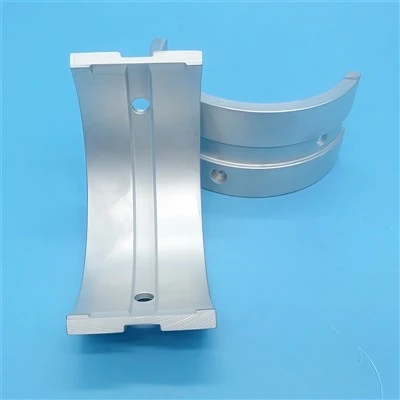
Before we dive into power loss calculations, it’s essential to understand what fluid film thrust bearings are and how they work. Fluid film thrust bearings are designed to support axial loads by maintaining a thin film of lubricant between the bearing surfaces. This lubricant film separates the moving parts, reducing friction and wear while allowing for smooth rotation.
The operation of fluid film thrust bearings relies on the principle of hydrodynamic lubrication. As the shaft rotates, it drags the lubricant into the converging gap between the bearing surfaces, creating a pressure wedge that supports the load. The thickness of the lubricant film is critical, as it determines the level of friction and power loss in the bearing.
Factors Affecting Power Loss
Several factors influence the power loss in fluid film thrust bearings. Understanding these factors is essential for accurate calculation and efficient bearing design.
Viscosity of the Lubricant
The viscosity of the lubricant plays a significant role in power loss. Higher viscosity lubricants offer better load-carrying capacity but also result in increased friction and power loss. Conversely, lower viscosity lubricants reduce friction but may not provide sufficient support for heavy loads. Selecting the appropriate lubricant viscosity is crucial for minimizing power loss while ensuring reliable bearing performance.
Rotational Speed
The rotational speed of the shaft directly affects the power loss in fluid film thrust bearings. As the speed increases, the shear forces within the lubricant film also increase, leading to higher power consumption. Additionally, high rotational speeds can cause the lubricant to heat up, further increasing viscosity and power loss.
Load
The applied load on the bearing is another critical factor influencing power loss. Higher loads require a thicker lubricant film to prevent metal-to-metal contact, which increases the frictional forces and power consumption. Properly sizing the bearing to handle the expected loads is essential for minimizing power loss.
Bearing Geometry
The geometry of the bearing, including the bearing area, clearance, and surface finish, also affects power loss. A larger bearing area provides more support for the load but may increase friction. The clearance between the bearing surfaces must be carefully controlled to maintain an optimal lubricant film thickness. Additionally, a smoother surface finish reduces friction and power loss.
Calculation Methods
There are several methods available for calculating the power loss in fluid film thrust bearings. The choice of method depends on the level of accuracy required and the complexity of the bearing design.
Analytical Methods
Analytical methods are based on mathematical models that describe the behavior of the lubricant film and the bearing surfaces. These models typically make simplifying assumptions to reduce the complexity of the calculations. One commonly used analytical method is the Petroff’s equation, which provides an estimate of the power loss based on the bearing geometry, rotational speed, and lubricant viscosity.
The Petroff’s equation is given by:
[P = \mu \omega A \left(\frac{h_0}{r}\right)]
where (P) is the power loss, (\mu) is the dynamic viscosity of the lubricant, (\omega) is the angular velocity of the shaft, (A) is the bearing area, (h_0) is the minimum lubricant film thickness, and (r) is the effective radius of the bearing.
While Petroff’s equation is a simple and convenient method for estimating power loss, it assumes a fully flooded bearing and neglects the effects of load and temperature. For more accurate calculations, more sophisticated analytical models may be required.
Numerical Methods
Numerical methods, such as finite element analysis (FEA) and computational fluid dynamics (CFD), offer a more detailed and accurate approach to power loss calculation. These methods can account for the complex geometry of the bearing, the behavior of the lubricant under various conditions, and the effects of load and temperature.
FEA involves discretizing the bearing and the lubricant film into a mesh of small elements and solving the governing equations numerically. CFD, on the other hand, focuses on the fluid flow within the bearing and uses numerical algorithms to simulate the behavior of the lubricant.
Numerical methods are more computationally intensive than analytical methods but provide more accurate results. They are particularly useful for analyzing complex bearing geometries and operating conditions.
Experimental Methods
Experimental methods involve measuring the power loss in a physical bearing using specialized testing equipment. These methods provide the most accurate results but are also the most expensive and time-consuming.
One common experimental method is to measure the torque required to rotate the bearing at a given speed and load. The power loss can then be calculated by multiplying the torque by the angular velocity.
Experimental methods are often used to validate the results of analytical and numerical calculations and to develop empirical correlations for power loss prediction.
Importance of Accurate Power Loss Calculation
Accurate power loss calculation in fluid film thrust bearings is essential for several reasons.
Energy Efficiency
Minimizing power loss in bearings is crucial for improving the energy efficiency of mechanical systems. By reducing friction and power consumption, energy losses can be significantly reduced, leading to cost savings and a lower environmental impact.
Bearing Life
Excessive power loss can cause the lubricant to overheat, leading to premature wear and failure of the bearing. Accurate power loss calculation allows for proper bearing sizing and lubricant selection, ensuring reliable operation and extending the bearing life.
System Performance
The power loss in bearings can affect the overall performance of mechanical systems. High power consumption can result in increased vibrations, noise, and reduced efficiency. By accurately calculating and minimizing power loss, the performance of the system can be improved.
Conclusion
Calculating the power loss in fluid film thrust bearings is a complex but essential task for ensuring the efficiency and reliability of mechanical systems. As a supplier of fluid film thrust bearings, I understand the importance of accurate power loss calculation in providing high-quality products and solutions.
By considering the factors that affect power loss, choosing the appropriate calculation method, and using accurate models and data, engineers can optimize the design of fluid film thrust bearings and minimize power consumption. Whether you’re designing a new system or looking to improve the performance of an existing one, accurate power loss calculation is key.
Babbitt Journal Bearings If you’re interested in learning more about fluid film thrust bearings or need assistance with power loss calculation, I encourage you to reach out. Our team of experts is here to provide you with the support and guidance you need to make informed decisions and achieve your engineering goals. Contact us today to start a conversation about your specific requirements.
References
- Hamrock, B. J., Schmid, S. R., & Jacobson, B. O. (2004). Fundamentals of Fluid Film Lubrication. McGraw-Hill.
- Szeri, A. Z. (2005). Fluid Film Lubrication: Theory and Design. Cambridge University Press.
- Townsend, D. P. (1992). Dudley’s Gear Handbook: Design, Manufacture, and Application. McGraw-Hill.
Wenzhou Zhengbang Bearing Co., Ltd.
We are one of the most professional fluid film thrust bearings manufacturers and suppliers in China. With abundant experience, we warmly welcome you to buy customized fluid film thrust bearings at competitive price from our factory. If you have any enquiry about free sample, please feel free to email us.
Address: Units 1-1 and 3-1, Building 12, Yongxing Nanyuan Small and Micro Enterprise Startup Park, Binhai 2nd Road, Yongxing Subdistrict, Longwan District, Wenzhou City, Zhejiang Province.
E-mail: zbbearing@zbbearing.com
WebSite: https://www.zb-bearings.com/
